

Artificial Intelligence is rapidly transforming the cybersecurity landscape, creating a high-stakes race between attackers and defenders. While organisations are leveraging AI to automate threat detection and strengthen cyber resilience, threat actors are using the same technologies to launch increasingly sophisticated attacks at unprecedented scale.
The cybersecurity profession is therefore entering a new era. Security teams are no longer defending against conventional threats alone; they are confronting AI-generated phishing campaigns, deepfake-enabled social engineering attacks, adaptive malware, and highly automated attack frameworks capable of evolving in real time.
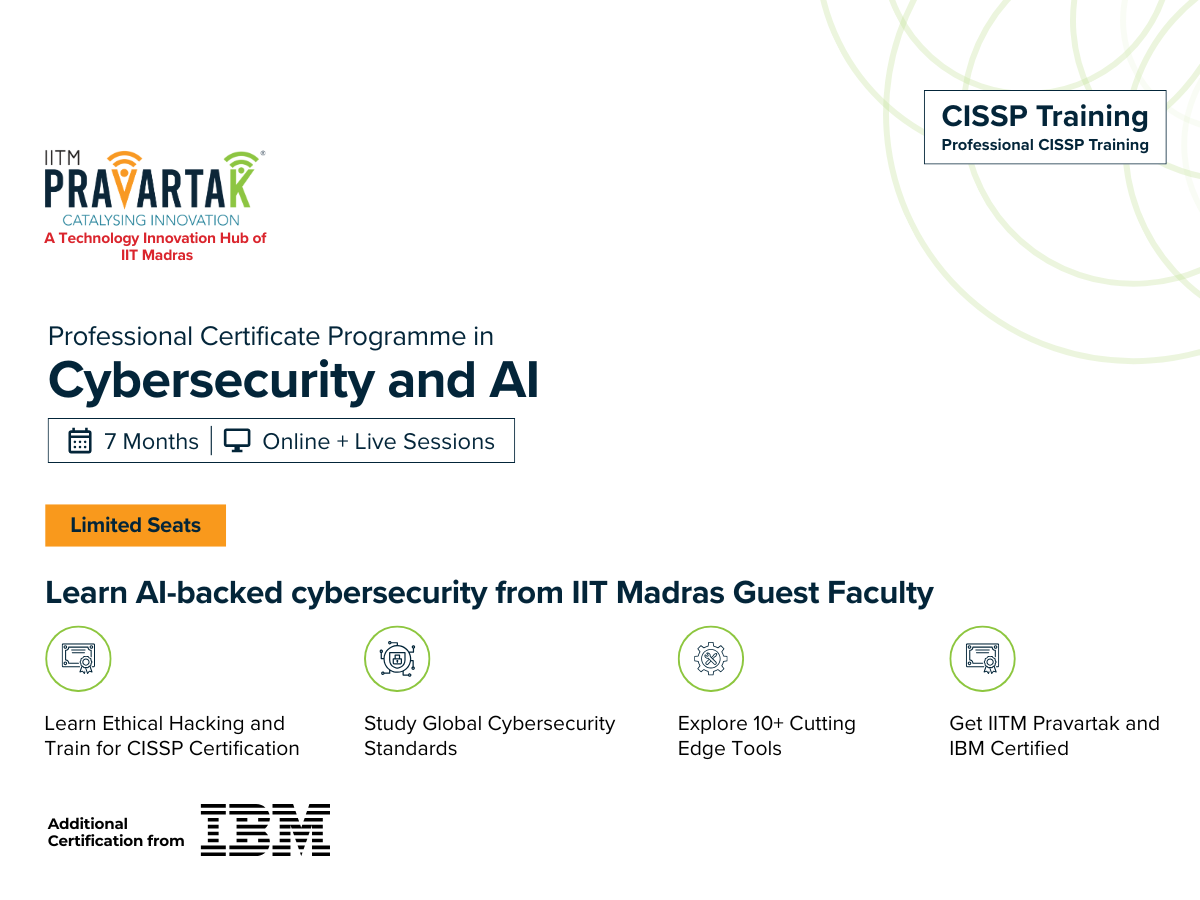
As organisations race to build AI-powered security capabilities, the demand for professionals who understand both cybersecurity and artificial intelligence is accelerating. To address this emerging skills gap, IITM Pravartak has launched the Professional Certificate Programme in Cybersecurity and AI, a comprehensive programme designed to help professionals develop expertise across modern cyber defence, offensive security, AI-driven threat detection, cloud security, digital forensics, and cybersecurity architecture.
According to the 2024 ISC2 Cybersecurity Workforce Study, the global cybersecurity workforce gap has reached nearly 4.8 million professionals. Closer to home, industry reports indicate that more than 28,000 cybersecurity positions remain unfilled in India, while 75% of organisations report challenges in hiring skilled cybersecurity talent. At the same time, IBM’s Cost of a Data Breach Report 2024 estimates the average global cost of a breach at USD 4.88 million—the highest recorded to date.
Against this backdrop, the role of the cybersecurity professional is evolving rapidly.
The New Cybersecurity Battlefield
Today’s threat landscape is being reshaped by AI on both sides of the security equation
Cybercriminals are increasingly leveraging AI to:
- Generate highly personalised phishing campaigns at scale
- Create convincing deepfakes for identity fraud and social engineering
- Develop adaptive malware capable of bypassing traditional controls
- Automate reconnaissance and attack execution
- Increase the speed and volume of cyberattacks
Meanwhile, organisations are deploying AI-powered security capabilities to improve detection, response, and resilience.
As India accelerates initiatives such as Digital India, 5G deployment, smart cities, API-driven digital infrastructure, and cloud adoption, the need for AI-ready cybersecurity talent is becoming increasingly urgent. Industry estimates suggest India’s cybersecurity market is expected to grow at more than 18% CAGR through the decade, creating significant demand for specialised talent.
Why Cybersecurity Professionals Need AI Expertise
Modern cybersecurity roles extend far beyond network monitoring and infrastructure protection.
Security teams are increasingly expected to work with:
- AI-powered anomaly detection systems
- User and Entity Behaviour Analytics (UEBA)
- Machine learning-driven threat detection models
- Security automation through SIEM and SOAR platforms
- AI governance and explainability frameworks
- Adversarial AI defence mechanisms
Recognising this shift, IITM Pravartak’s Professional Certificate Programme in Cybersecurity and AI incorporates a dedicated AI in Cybersecurity curriculum that explores how AI can both strengthen and threaten modern security systems.
Participants gain exposure to areas such as:
- Deep Learning and NLP for Cybersecurity
- AI-Driven Anomaly and Malware Detection
- Adversarial Attacks and Model Robustness
- AI Integration with SIEM and SOAR
- Threat Hunting using MITRE ATT&CK
- Ethics and Governance in AI Security
The objective is to help professionals understand not only how AI can be used for defence, but also how attackers are increasingly weaponising it.
Building Defenders Who Understand Attackers
While AI is transforming cybersecurity operations, strong security fundamentals remain critical.
Effective cybersecurity professionals must understand how attacks are planned, executed, and investigated before they can build effective defence strategies.
To address this requirement, the programme delivers practical exposure across both offensive and defensive security disciplines, including ethical hacking, vulnerability assessment and penetration testing (VAPT), cloud security, Security Operations Centre (SOC) operations, digital forensics, incident response, and security architecture.
Participants also gain hands-on experience with more than 10 widely used cybersecurity tools including Nmap, Metasploit, SEToolkit, OpenVAS, Nessus, Wireshark, and SQLMap, helping bridge the gap between theoretical knowledge and operational capability.
This dual perspective helps learners develop a more complete understanding of modern cyber risk while strengthening their ability to identify, assess, and mitigate threats.
From Learning to Industry Readiness
Cybersecurity employers increasingly seek professionals who can contribute immediately in operational environments.
The programme places significant emphasis on practical application through:
- Hands-on projects
- Real-world case studies
- Expert-led live sessions
- Applied tool-based learning
- A comprehensive capstone project
Learning is reinforced through practical scenarios such as AI-driven SOC automation, security breach investigations, secure cloud IAM configurations, phishing detection using NLP, and digital forensics exercises.
The programme is delivered through a blended learning format featuring weekly recorded content and select masterclasses from IITM Pravartak guest faculty, combined with live sessions led by domain experts. Successful participants also have the opportunity to attend a two-day optional immersion at IIT Madras Research Park, enabling deeper engagement with the broader technology ecosystem.
This focus on applied capability development is particularly relevant as cyber threats continue to escalate. Recent industry reports indicate more than 369 million malware detections across 8.44 million endpoints in India, highlighting the scale of the challenge facing organisations.
Building Strategic Cybersecurity Expertise for the Age of AI
Cybersecurity has become a strategic business issue rather than a purely technical function.
Today’s professionals must increasingly navigate:
- Cyber risk management
- Security governance
- Regulatory compliance
- Enterprise security architecture
- AI risk management
To support this evolution, the programme integrates CISSP training aligned with one of the world’s most respected cybersecurity credentials. The curriculum covers key domains including security and risk management, security architecture and engineering, communication and network security, identity and access management, security operations, and software development security.
The learning experience is further strengthened through three IBM certifications focused on:
- Generative AI Skills for Cybersecurity Professionals
- Fundamentals of Encryption and Quantum-Safe Techniques
- Cybersecurity Forensic Analysis and Incident Response
Combined with certification from IITM Pravartak, these credentials help participants build both technical depth and broader cybersecurity expertise relevant to modern organisations.
Building the Next Generation of Cybersecurity Talent
The future of cybersecurity belongs to professionals who can combine deep security expertise with AI-powered defence capabilities.
As cybercriminals continue to weaponise AI and organisations increasingly deploy intelligent security systems, the need for hybrid cybersecurity talent will only intensify.
The Professional Certificate Programme in Cybersecurity and AI by IITM Pravartak has been designed to meet this moment. Through integrated CISSP training, AI-powered cybersecurity modules, hands-on exposure to industry tools, three IBM certifications, applied projects, and expert-led learning, the programme equips professionals with the knowledge and practical skills required to secure the next generation of digital enterprises.
